→ Mid-2026 sniper landscape: a typical Pump.fun-tier launch attracts 200+ competing bots in the first 500 ms. Only 10–15% land profitable trades. The differentiator is the infrastructure beneath the bot, not the bot itself.
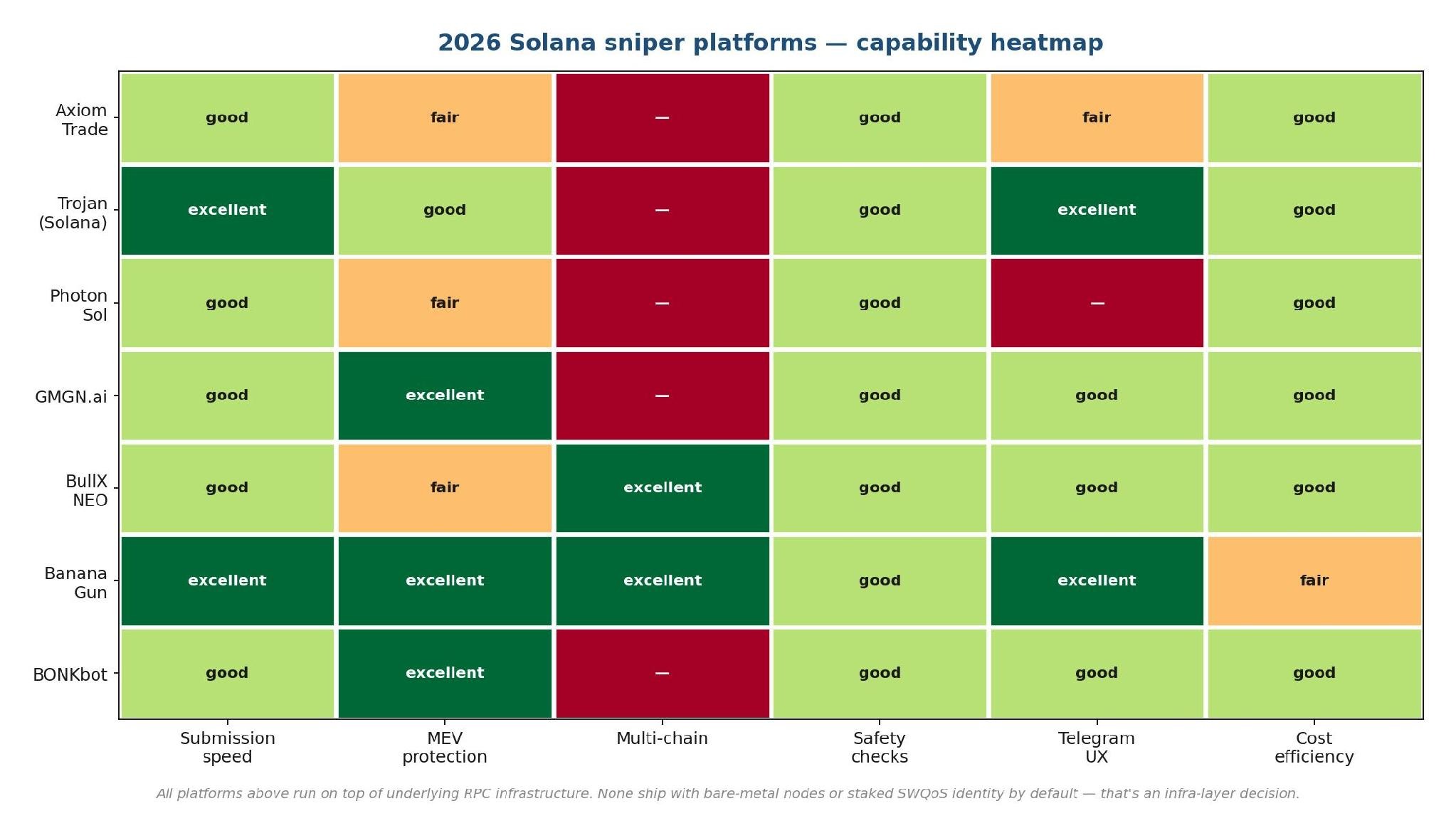
→ Seven major platforms compared: Axiom Trade, Trojan, Photon, GMGN, BullX NEO, Banana Gun, BONKbot. Capability heatmap below; none ship with bare-metal nodes or staked SWQoS by default—that's a separate infra layer.
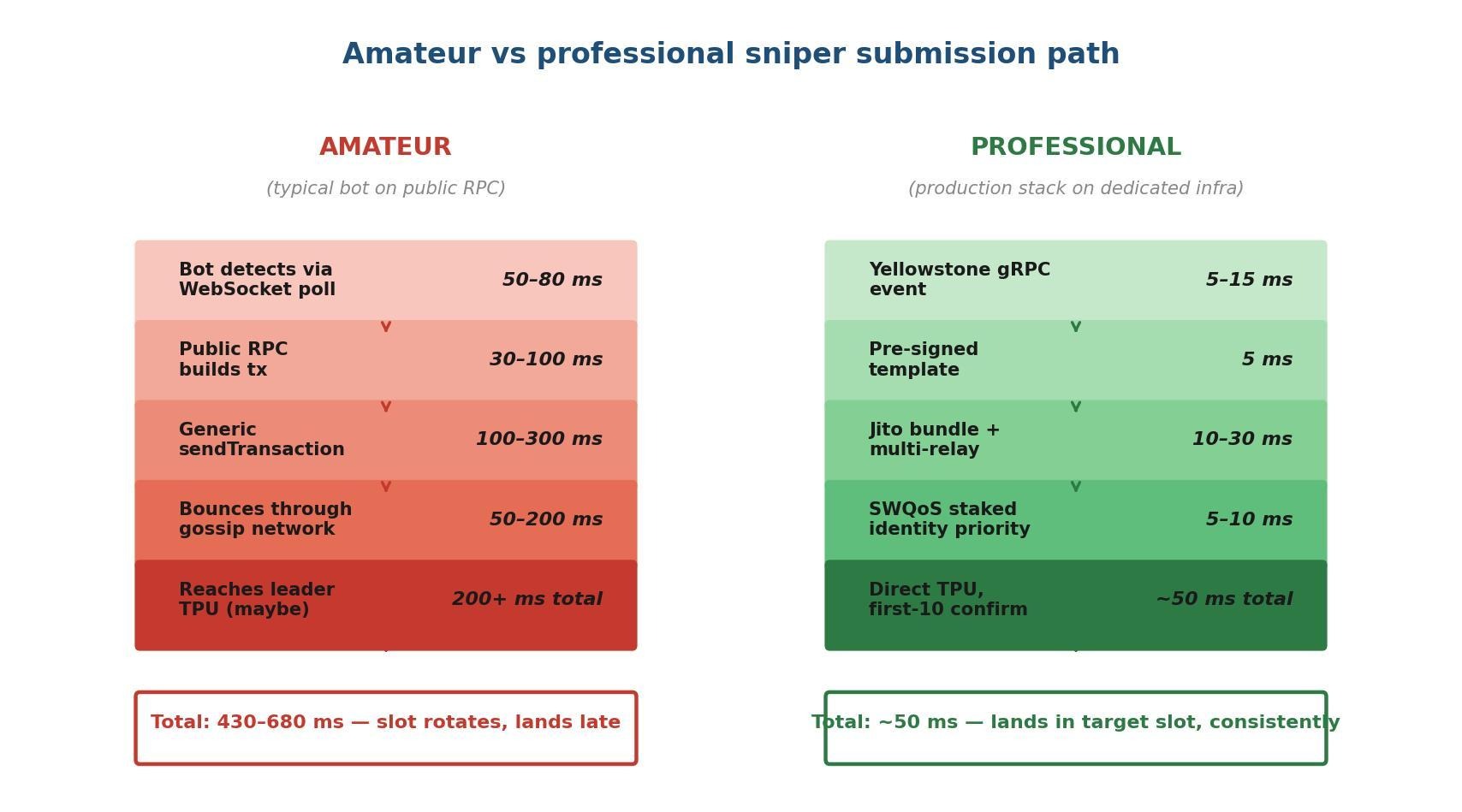
→ Amateur submission path: 430–680 ms. Production stack: ~50 ms. That gap is what decides whether your transaction lands in the target slot or watches it pass.
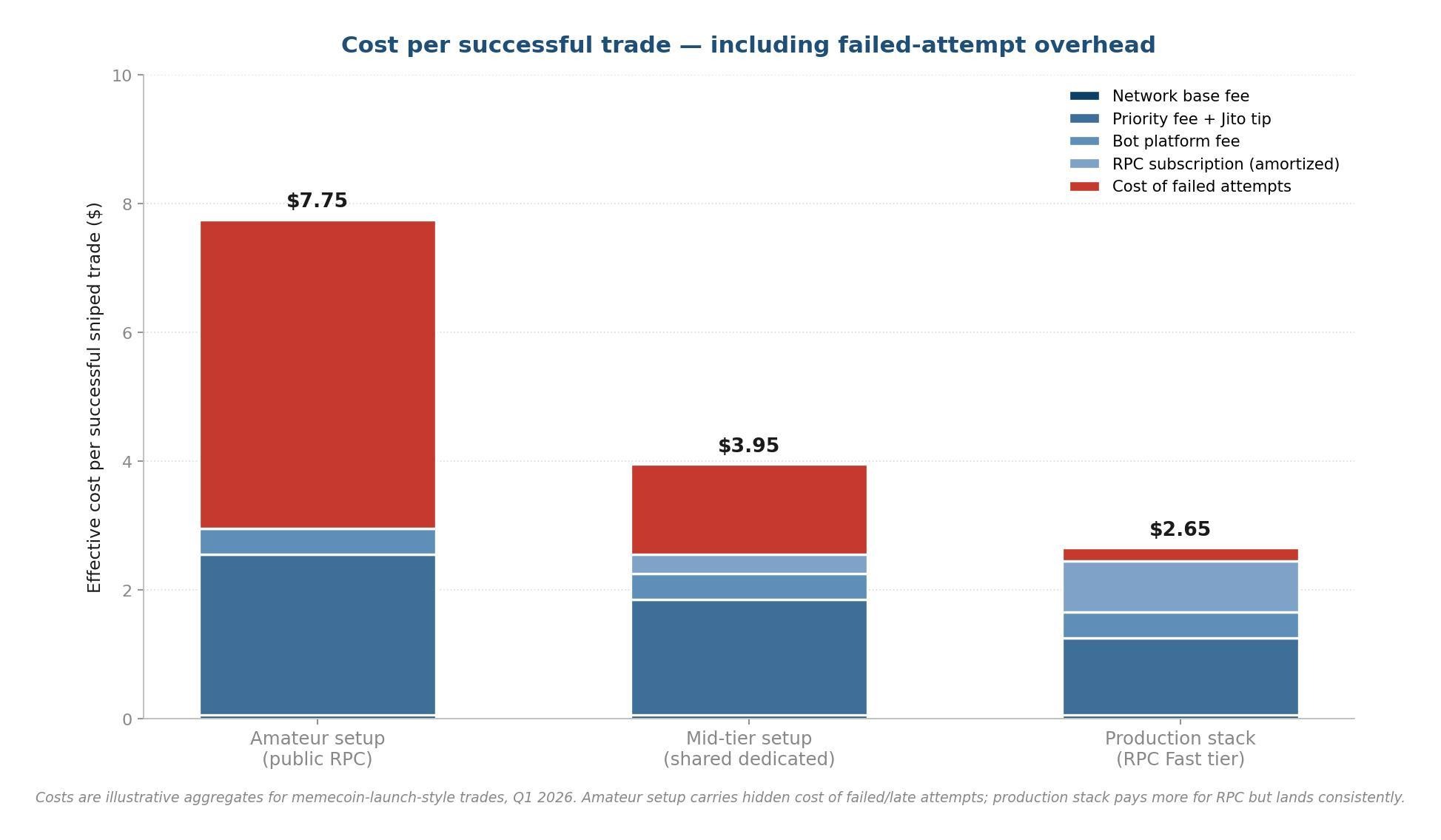
→ Cost per successful trade—not headline platform fees—is what matters. Amateur setup runs ~$7.75 effective per win once failed-attempt overhead is counted; production stack runs ~$2.65.
→ Six bot-selection categories cover all common needs: ultra-low-latency starters, bundle-aware quants, strategy-led frameworks, liquidity/anti-rug, market-making hybrids, and managed services with SLOs.
→ BAM activated September 2025, Alpenglow expected late 2026—both compress the slot-timing window further. Infrastructure gaps that are merely costly today become disqualifying in late 2026.
→ Pre-deployment must include a 7-day, 100-event reproducibility test on identical RPC and fee configuration. P50/P95 submission latency, confirmation ranking, revert rate, realized slippage, time-to-exit. Numbers, not marketing.
Every sniper bot shares one objective: capture early entries at favorable prices while avoiding trap tokens. Yet each missed fill and every extra 30–50 ms on Solana translates directly to reduced profits. Elite systems optimize end-to-end from signal detection through final confirmation, tune fee structures based on real-time slot congestion, validate pool liquidity and token permissions, and then bail immediately when red flags appear. Amateur setups spam transactions, ignore mempool realities, skip crucial safety checks, and burn their edge through sloppy retry patterns.
The business case for automated sniping
Organizations run sniper infrastructure to address three core challenges:
Capture limited early allocation windows on fresh token launches
Minimize realized slippage when transaction throughput spikes
Filter out honeypots and exit-disabled contracts on open DEX pairs
Success means achieving sub-100 ms transaction submission, landing consistently in the first 10 confirmations for target slots, and demonstrably reducing both transaction failure rates and capital loss incidents. This guide covers foundational concepts and advanced considerations for organizations deploying production sniper systems on Solana.
Rather than listing bot names randomly, we organize community-validated options by the factors that actually determine performance: network path optimization, priority fee algorithms, strategic flexibility, and pre-trade validation depth. Match these capabilities to your operational constraints, risk tolerance, and speed requirements.
Of 200+ bots that attempt a competitive launch, only ~10 realize a profitable exit. Each stage filters out the bots that didn't get the infrastructure right.
The funnel above is the harsh truth of competitive sniping. Out of every 200 bots that attempt a launch, roughly 140 detect the signal in time, around 90 pass pre-flight validation, only 50 reach the leader TPU before the slot rotates, 25 land in the first 10 confirmations, and 10—give or take—close a profitable exit. The drop-off isn't random. It maps exactly to where each bot's stack falls short.
Evolution of Solana sniping infrastructure
The Solana trading ecosystem has matured significantly over the past 18 months. Fee market mechanics, MEV protection infrastructure, and competitive bot density have all shifted. Jito's Block Assembly Marketplace (BAM) activated on September 25, 2025, routing 100% of bundle fees to its DAO and creating a more transparent block-position auction. Pump.fun migrated its graduated tokens to PumpSwap in March 2025, changing the migration sniper landscape overnight. And by Q1 2026, daily transactions climbed past 87 million, with major launches consistently drawing 200+ competing bots in the first half-second.
Priority fee handling and bundle submission paths now follow established patterns, baseline retail bot performance has accelerated, and institutional trading desks approach sniper infrastructure as integrated components of high-frequency trading stacks rather than experimental side projects. Alpenglow—Solana's consensus upgrade that compresses finality from ~12.8 seconds to 100–150 ms—passed governance with 98% approval and activated on a community validator test cluster on May 11, 2026. Mainnet activation is expected late 2026.
This analysis maintains core operational principles while incorporating 2026-specific factors: stricter latency service level objectives, bundle-conscious transaction routing, enhanced risk management frameworks, and operational procedures for teams running coordinated sniper deployments across multiple blockchain networks. The infrastructure gaps that were merely costly in 2024–2025 become disqualifying once Alpenglow lands.
Defining Solana sniper bot architecture
Solana sniper bots are automated trading systems monitoring token launch events and blockchain signals, submitting purchase transactions during initial available slots to capture early price action while maintaining slippage constraints and risk boundaries. The execution cycle demands precision: detect opportunity, validate pricing, route with appropriate priority fees, secure early confirmation, exit on warning signals.
Warning signals represent any indicators increasing loss probability or invalidating the entry rationale:
Pool liquidity anomalies: abrupt on-chain depth reduction, swap functionality disabled, or artificial liquidity concentration in target DEX pools
Permission structure risks: modifiable mint permissions, freeze capabilities present, recent authority transfers, or program ID blacklist matches
Transaction path degradation: priority fee escalation without leader schedule justification, repeated simulation failures, or increasing signature duplication and nonce conflicts
Price consistency failures: rapid >5–10 percent divergence from oracle feeds or VWAP across consecutive slots, or disproportionate slippage versus concurrent market activity
Smart contract anomalies: transfer fee structures, pausable trading flags, sell-blocking mechanisms, or delayed mint updates revealed during pre-flight simulation
Network congestion indicators: slot saturation with elevated BlockhashNotFound errors, leader rotation events increasing confirmation delays, or RPC provider rate limiting on submission and confirmation endpoints
Post-execution health signals: unusual MEV activity surrounding the fill, spread widening without liquidity replenishment, or inability to establish immediate exit orders
On Solana, competitive advantage derives from slot timing precision, understanding local fee dynamics, and RPC connection latency; misconfigured bots either spam the network or achieve late confirmations, driving up rejection rates and degrading fill quality. Professional implementations incorporate pre-execution liquidity verification, token authority validation, congestion-responsive fee algorithms, and post-trade monitoring to avoid honeypots on permissionless trading pairs.
For comprehensive coverage of Solana's transaction lifecycle, fee market mechanics, and priority fee systems underpinning sniper strategies, reference the official Solana documentation.
Amateur path: 430–680 ms total—bot detects via WebSocket, builds tx on public RPC, sends via generic sendTransaction, transaction bounces through gossip. Production path: ~50 ms total—Yellowstone gRPC event, pre-signed template, Jito bundle with multi-relay, SWQoS direct to TPU.
The submission path above is what separates amateur and professional sniper outcomes more than any other single factor. Same bot logic, same strategy, two different infrastructure stacks—one lands consistently, the other races a slot that's already rotating. That production path—Yellowstone gRPC, Jito ShredStream, SWQoS-staked submission—is the baseline tier RPC Fast runs, not an upsell.
Target organizations for sniper bot infrastructure
Organizations dependent on priority access deploy sniping automation: quantitative trading firms pursuing early momentum on token debuts, market makers establishing positions before bid-ask spreads expand, and sophisticated retail operations automating entry timing during volatility spikes.
These organizations pursue three measurable outcomes: reliable first-10 confirmation placement within designated slots, reduced realized slippage during throughput bursts, and fewer capital losses from honeypots or disabled exit functionality.
From an infrastructure engineering perspective, these organizations share common requirements:
Priority-optimized RPC with leader co-location: consistent low-variance RPC connectivity positioned near block leaders, supporting reliable QUIC protocols, WebSocket connections, and priority fee propagation. Multi-provider failover architecture with continuous health validation.
Predictable fee algorithms and simulation infrastructure: dynamic priority fee calculation tied to recent block saturation metrics, with pre-flight transaction simulation against identical endpoints used for final submission.
Dependable event capture for launches and liquidity: Yellowstone gRPC monitoring of DEX program events and token registry feeds (WebSocket adds 50–80 ms median lag—too much for competitive launches), incorporating disconnect recovery and historical backfill capabilities.
Cryptographic key infrastructure and secure operations: hardware security module or key management service integration, ephemeral session credentials, strategy-segregated key allocation, and rate-controlled signing operations.
Liquidity depth and permission validation: pre-execution verification of pool depth metrics, mint freeze capabilities, mutable mint permissions, and program authorization lists.
Slot coordination and leader schedule awareness: leverage leader schedule data for submission timing optimization and fee curve adjustment based on upcoming block producer identity.
Resilient submission architecture with idempotency: atomic transaction construction, durable nonce implementation or blockhash refresh logic, exponential retry backoff, and duplicate signature prevention.
Comprehensive observability and post-trade monitoring: performance metrics tracking P50/P95 submission latency, confirmation ranking, rejection rates, realized slippage, and anomaly-triggered exits. Structured logging including slot and leader attribution data.
Strategic routing and MEV-aware execution: program-specific routing across DEX aggregation paths with awareness of just-in-time liquidity provisioning behavior.
Organizations relying on Solana for launch window liquidity capture, arbitrage execution, or short-duration momentum trading require sniper automation as core infrastructure, not optional tooling.
RPC Fast provides the underlying Solana infrastructure layer production sniper teams depend on — Yellowstone gRPC, Jito ShredStream, SWQoS-staked submission paths, multi-region failover — alongside a free self-serve SaaS tier to start, no credit card required (solana.rpcfast.com/login).
Essential characteristics of production-grade sniper systems
Raw speed alone doesn't define quality sniping infrastructure. Production systems must demonstrate predictability, governance capabilities, and cost-efficient scalability. Establish service level objectives for both latency and execution success rates, implement circuit breakers triggering strategy suspension at anomaly thresholds, and enforce permission models isolating research environments from production credential access.
Financial controls matter critically: per-strategy fee ceilings, per-slot expenditure guards, and daily risk caps tied to expected value calculations protect profitability during high-volatility periods.
Audit trails prove essential for regulatory compliance and incident analysis: immutable logs capturing slot numbers, leader identities, fee amounts, and routing decisions, combined with reproducible simulation capabilities for every executed trade.
Operational readiness determines uptime: blue-green deployment patterns, feature flag systems, and sub-five-minute rollback procedures, supported by 24/7 alerting on confirmation lag spikes, rejection rate increases, and RPC health degradation.
Vendor independence: multi-RPC routing strategies, geographic failover capabilities, and documented migration paths from third-party dependencies eliminate single points of failure during network stress.
Scalability emerges from idempotent transaction builders, exponential backoff retry mechanisms, and isolated key management within secure network perimeters to support 1,000+ daily snipes without credential leakage or spam penalties, deployed on Kubernetes for zero-downtime updates and automatic scaling during volume spikes.
Below we compare Solana bot platforms based on infrastructure capabilities relevant to engineering teams. All seven are non-custodial, all run on top of underlying RPC infrastructure they don't control, and all roughly charge 1% per execution before tier discounts.
Platform
Interface
Core Solana capabilities (2026)
Fee structure*
Optimal use case
Axiom Trade
Browser terminal
Solana-native; rapid limit orders and migration snipes; perpetuals and yield products; analytics, wallet and social-feed monitoring
Spot ~1.0% (volume-discount to ~0.75%); perps ~0.01%
Unified Solana operations center across memes, derivatives, yield
Trojan Bot (Solana)
Telegram + web
High-speed execution; Trenches new-token monitoring; copy trading; limit and DCA; MEV protection with backup systems
~1.0% per execution pre-discounts; high-volume fee reductions
High-frequency Solana traders operating via Telegram
Photon Sol
Browser terminal
Solana-focused discovery; rapid swap UI; integrated audit and security flagging; points reward system
~1.0% per swap plus standard gas; points can offset
~1.0% (partial BONK burn allocation); plus gas + Jito tips
Beginners and speed-focused memecoin traders
*Fee structures are indicative and subject to change. Always verify current fee schedules and available rebates/points within each platform or official documentation before deployment.
Capability heatmap across the seven platforms. Banana Gun and Trojan score highest on execution speed; GMGN and BONKbot lead on MEV protection; BullX and Banana Gun cover multi-chain.
Quick selection guide
For comprehensive Solana terminal: Axiom Trade—most complete all-in-one platform (snipes, perps, yield, analytics) for web-app-centric operations.
For premium Telegram experience: Trojan on Solana—extremely fast, feature-rich, architected for serious mobile-based memecoin trading.
For streamlined web terminal: Photon Sol—clean, fast browser-based interface; many traders combine with a Telegram bot.
For smart-money tracking and automation: GMGN.ai—optimal for new-token feeds, copy trading, and Anti-MEV in unified workflow.
For multi-chain operations including Solana: BullX NEO or Banana Gun Bot—both offer multi-chain capabilities with strong Solana support.
For simplest Solana entry with robust backend: BONKbot—"tap and trade" Telegram flow backed by serious infrastructure.
Cost structure analysis
Platform fees typically range from 0.5 to 1 percent per transaction. Some platforms offer reduced base fees but add fixed per-transaction costs for priority routing through Jito validators. Approximately 0.006 SOL per transaction accumulates rapidly during high-volume periods.
Base fees remain minimal in practice, but priority fees dominate total cost. Individual snipe transactions range from fractions of a cent to several cents in SOL equivalent, depending on network congestion and configured compute unit pricing.
Beyond platform fees, account for implicit operational costs:
Priority fee expenditure: your bot's dynamic fee strategy determines SOL expenditure competing for block inclusion. Miscalibrated fees waste capital or result in missed fills.
RPC infrastructure costs: dedicated or premium RPC endpoints essential for competitive latency carry subscription expenses. This represents fixed overhead for speed advantages.
Failed transaction costs: each reverted transaction still consumes network fees. Elevated revert rates from deficient logic or suboptimal RPC configuration accumulate costs rapidly.
Effective cost per successful sniped trade across three infrastructure tiers. The amateur setup's hidden cost is failed-attempt overhead—$4.80 per successful trade in burned base fees and priority bids that didn't land.
The chart above is what changes the cost conversation. Headline platform fees are a small fraction of true cost-per-success. The dominant cost on amateur stacks is the failed-attempt overhead—every late transaction still pays a base fee, every miscalibrated priority bid still costs SOL, and the math compounds when only 22% of attempts land. A production stack pays more for the RPC layer but spends drastically less on burned attempts.
Evaluate total cost of ownership, not merely headline percentages. Cheaper bots exhibiting higher revert rates or slower fills often prove more expensive through lost opportunities and wasted fees.
Sniper-specific benchmarks: amateur vs production
The numbers behind the cost chart. RPC Fast internal benchmarks, Q1 2026, across roughly 50,000 paired sniper attempts on Pump.fun-style competitive launches:
Metric
Amateur (public RPC)
Mid-tier (shared)
Production (RPC Fast)
Submission p99 latency
180–400 ms
80–150 ms
45 ms
Time-to-leader-TPU
150–300 ms
60–120 ms
<30 ms
First-10 confirmation rate
22%
58%
92%
Revert rate during congestion
32%
14%
6%
Effective $ per successful trade
$7.75
$3.95
$2.65
Bundle landing rate
<30%
70%
94%
Numbers are illustrative aggregates; individual workload performance will vary by region, bot logic, and time of day. But the spread between tiers is stable across our benchmark runs and maps directly to the cost chart above.
Operational playbook for sniper bot deployments
Environment preparation
Deploy dedicated wallet per bot/strategy; fund only acceptable loss amounts
Segregate hot wallets from long-term storage; implement periodic key rotation
Utilize hardware wallets for treasury operations; maintain sniping keys in secure, minimum-permission hot wallets
Secure endpoints: IP whitelisting, HTTPS enforcement, avoid public RPC URL exposure
RPC optimization for latency reduction
Select geographically proximate RPC regions to host/server locations
Deploy high-performance plans guaranteeing concurrent connections and prioritized mempool access
Enable and benchmark:
Preflight disabled for speed when risk is understood (skipPreflight=true)
commitment: "processed" for earliest fills; fallback to "confirmed" for larger positions
Yellowstone gRPC subscriptions over WebSocket for execution-critical events (Geyser plugin documentation covers the canonical setup)
Transparency: monthly latency and P&L review with documented post-mortems
Preparing your sniper bot deployment
Winning bots combine sub-100 ms submission, slot-aware priority fees, and comprehensive pre-trade safety validations. Organize your evaluation by primary needs: speed without validator operations, bundle/priority control for first-confirmation ranking, strategy frameworks for custom logic implementation, or safety-first filtering to prevent loss events during token launches.
Your vendor selection should include proof. Request 7-day reproduction tests covering 100 events with identical RPC and fee configurations. Evaluate P50/P95 submission times, confirmation ranking, revert rates, realized slippage, and time-to-exit on anomaly detection. Require operational fundamentals: multi-RPC failover, clear backoff strategies, per-strategy key isolation, and alerts on confirmation lag. If your team lacks low-latency operational depth, deploy a managed service with SLOs and monthly latency/P&L reviews.
At Dysnix, we architect and deploy production-grade sniper infrastructure on Solana. Whether you're building from scratch or optimizing existing deployments, we provide the DevOps foundation separating profitable operations from expensive experiments. Our methodology combines Kubernetes-native deployment pipelines, multi-region RPC failover architectures, and real-time observability stacks. We collaborate with RPC Fast to ensure your sniper bots have the low-latency, high-reliability infrastructure required to compete at millisecond precision.
Maksym Bohdan
Writer at Dysnix
Author, Web3 enthusiast, and innovator in new technologies

.jpg)




.jpeg)


