For Solana trading bots and MEV infrastructure, RPC Fast is a strong specialist choice. Helius leads with Solana-native developer APIs, QuickNode offers broad multi-chain infrastructure, Alchemy combines RPC with usage-based data services, and Chainstack gives teams multiple node deployment models.
The performance argument for RPC Fast starts with transaction delivery. In its published Beam benchmark, transactions landed in 330 ms on average versus 457 ms through standard RPC, a 127 ms improvement. The test involved 20 runs per path under a specific infrastructure configuration, not a head-to-head benchmark against the other four providers.
For CTOs and infrastructure teams, choosing the best Solana RPC means analyzing complex workload scenarios under various environmental conditions. A provider serving getBalance efficiently might behave differently under heavy getProgramAccounts queries, Yellowstone gRPC subscriptions, or congestion-sensitive transaction submission.
This RPC provider comparison examines five major infrastructure options through the operational questions that matter: latency, streaming, transaction landing, throughput limits, economics, and deployment control.
Disclaimer: We checked provider features, publicly listed limits, and prices against official sources on October 27, 2026. Performance results are attributed to their publishers rather than presented as independent Dysnix measurements.
TL;DR
The deciding factor is the workload style, not the provider's overall feature count. For a typical wallet or non-latency-sensitive dApp, all five offer viable production paths.
The comparison below covers publicly documented capabilities. Pricing refers to monthly self-service rates unless otherwise specified; dedicated infrastructure and enterprise agreements have separate terms.
Official sources: Helius pricing, QuickNode pricing, Alchemy pricing, Chainstack pricing, and RPC Fast pricing.
RPC Fast concentrates on data freshness, workload-specific account access, transaction delivery, and dedicated infrastructure.
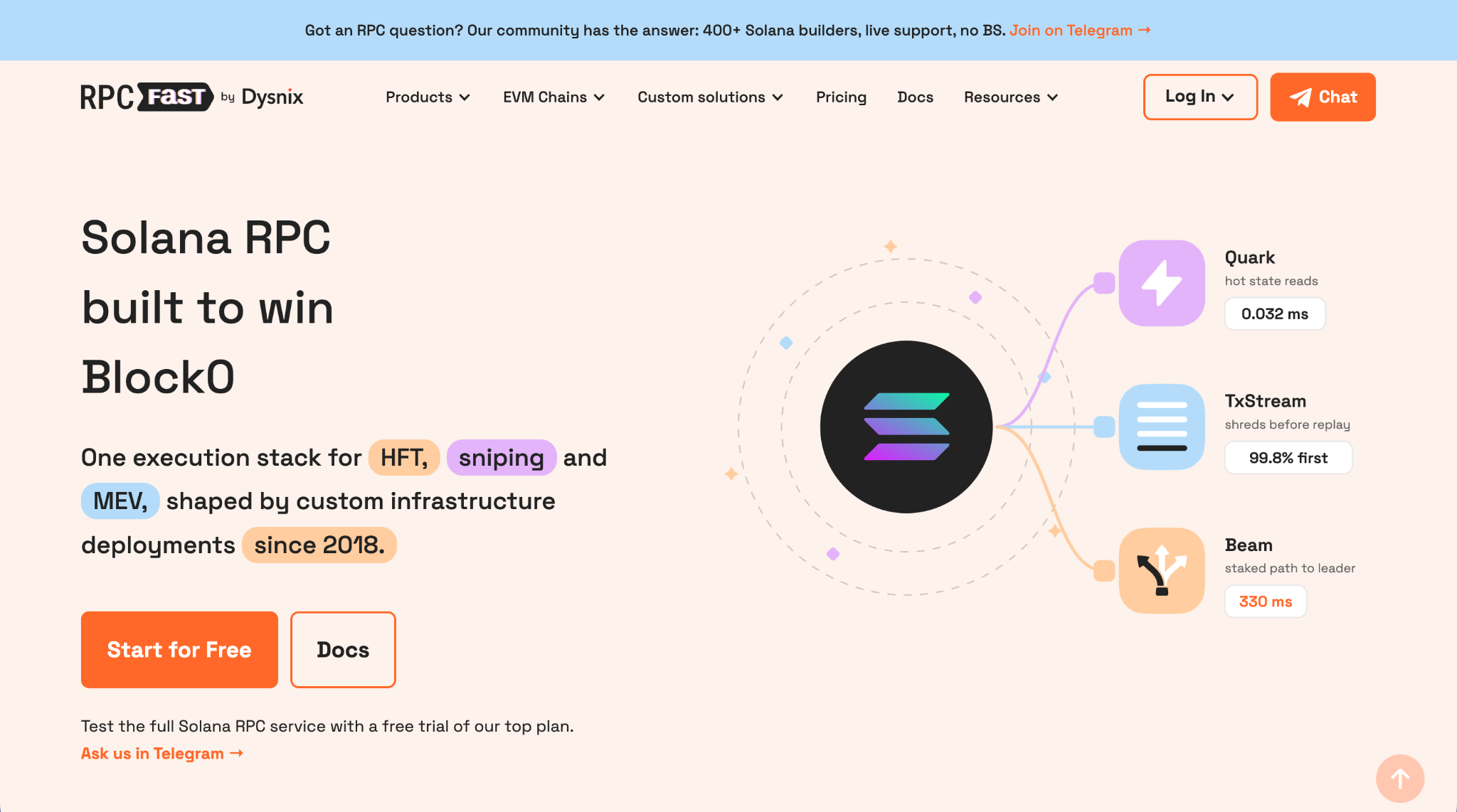
Its specialization becomes relevant when changing the data feed or transaction route improves a measurable trading outcome.
Helius combines RPC with asset APIs, parsed transaction data, webhooks, LaserStream, and Sender. That reduces the engineering effort needed to assemble a Solana application from separate infrastructure services.
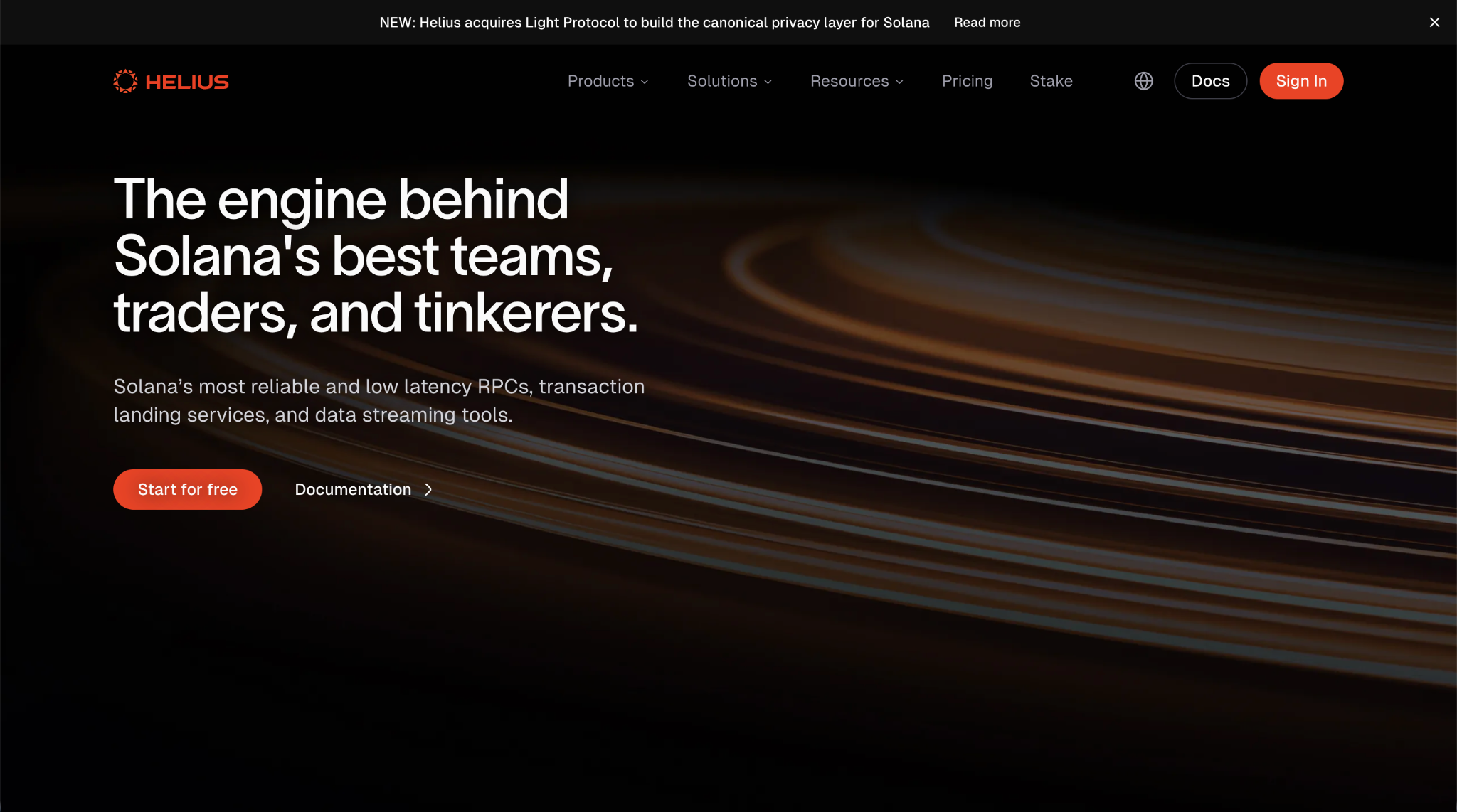
Its strength is particularly evident when the application needs indexed Solana data rather than direct validator responses alone.
QuickNode serves Solana alongside numerous other networks. Its infrastructure includes JSON-RPC, WebSockets, event streams, webhooks, gRPC, historical data, and dedicated deployments.
For a multi-chain platform, reducing the number of infrastructure vendors and integration patterns often matters more than optimizing one endpoint.
Alchemy offers a developer platform with RPC, monitoring, historical data, and Solana gRPC priced by transferred data. Its model is useful when workloads vary significantly over time.
The main evaluation question is whether usage-based charges remain favorable once peak throughput and data consumption are included.
Chainstack distinguishes between geographically balanced Global Nodes, region-specific Trader Nodes, and Dedicated Nodes.
That distinction matters operationally. Global routing favors general availability; fixed regional deployment favors predictable network locality.
The Helius vs QuickNode decision is primarily about Solana-specific functionality versus a broader infrastructure platform.
Helius concentrates on simplifying Solana development and supplying specialized execution services. QuickNode integrates Solana into a larger set of blockchain and developer infrastructure products.
Both support serious Solana workloads, including applications beyond ordinary JSON-RPC reads.
Neither provider is universally faster.
QuickNode publishes a regional Solana RPC performance comparison. Its displayed measurement includes p95 latency across five geographic regions, comparing QuickNode with other providers under the benchmark's own conditions. This is useful evidence, but the result depends on the tested methods, locations, infrastructure, and measurement period.
Helius also maintains performance-testing infrastructure and emphasizes optimized Solana access. Its products target several different performance requirements: RPC latency, stream delivery, and transaction landing.
A fastest RPC endpoint comparison becomes misleading when it combines those metrics.
Consider three operations:
getLatestBlockhash measures how quickly a node returns a recent blockhash. Freshness matters alongside response time.getProgramAccounts measures a query path affected by program size, filters, commitment, caching, and response payload.sendTransaction measures initial submission, not confirmed execution.Solana's official documentation explicitly states that successful sendTransaction acceptance does not guarantee transaction confirmation.
For trading applications, the third distinction has direct financial consequences. An endpoint returning an acknowledgment quickly might still route transactions through a slower path to the leader.
Dysnix hint: Run identical method mixes from the same client region and record p50, p95, and p99. Test transaction landing separately.
Both providers bill API activity using credits, but credits aren't equivalent across platforms.
Helius lists these plans:
Most standard Helius RPC calls consume one credit, while getProgramAccounts costs ten. Additional services have separate credit rules.
QuickNode lists:
According to QuickNode's API credit documentation, standard Solana RPC methods consume 30 API credits per call, with higher multipliers for selected advanced methods.
That changes the apparent volume advantage.
Worked example: One million standard Solana RPC requests
These figures describe standard method billing, not guaranteed capacity for arbitrary traffic patterns.
QuickNode Build's 80M credits therefore represent approximately 2.67M standard Solana requests. Its one-month free trial includes 10M credits, which represent about 333,000 such requests.
That is why comparing raw credit allocations leads to the wrong purchasing decision.
As a Solana-native provider, Helius supports specialized services and a cohesive Solana development experience.
QuickNode supports multiple blockchain ecosystems, including Ethereum, Solana, Bitcoin, and numerous EVM and non-EVM networks.
This difference matters for a product maintaining several chains.
Suppose an exchange backend supports Ethereum deposits, Solana wallets, Base-based assets, and Bitcoin settlement monitoring. QuickNode offers the advantage of consolidating infrastructure provisioning, billing, and operations.
A Solana-only protocol has little reason to care about that advantage.
Conversely, a trading strategy that requires specialized Solana feeds gains little operational benefit from support for dozens of unrelated networks.
Helius offers Solana-oriented APIs for asset data, transaction parsing, webhooks, and transaction submission. Applications avoid implementing some indexing and normalization logic themselves.
QuickNode provides SDKs, deployment tools, Streams, Webhooks, and add-ons through a common platform.
The integration trade-off concerns abstraction.
Provider-specific APIs shorten development for supported workloads but introduce dependencies that are harder to replace than standard JSON-RPC methods.
For example, migrating a basic getBalance call is straightforward. Replacing a custom parsed transaction API or managed webhook pipeline requires changes to data models, delivery semantics, and retry handling.
Teams expecting multiple future providers should isolate those services behind internal interfaces.
RPC Fast becomes relevant when neither API breadth nor multi-chain coverage is the primary constraint. Its architectural approach separates latency-sensitive functions:


For example, a market-making backend processing thousands of account changes should not treat its event stream as repeated getAccountInfo polling.
RPC Fast's streaming stack is a stronger architectural fit for that workload than its basic endpoint alone.
Nevertheless, Helius also supplies advanced streaming and transaction routes, while QuickNode supports Yellowstone-compatible gRPC and specialized execution products. The decision requires a workload-specific benchmark rather than a blanket performance ranking.
Alchemy vs Helius is a comparison between two platforms with different product histories, although their Solana capabilities increasingly overlap.
Alchemy emphasizes broadly applicable infrastructure, data services, and application operations. Helius emphasizes Solana-specific APIs and execution workflows.
For a team building exclusively on Solana, Helius offers specialized tooling without requiring integration into a broader blockchain platform.
Alchemy becomes particularly attractive for organizations operating several chains, maintaining historical datasets, or standardizing infrastructure consumption through a common commercial model.
However, describing Alchemy as purely enterprise infrastructure may be too narrow.
Its free tier and PAYG model also serve independent developers and smaller teams. Helius, meanwhile, operates enterprise-grade infrastructure with dedicated nodes, compliance capabilities, and custom SLAs.
The difference is emphasis, not an absolute division between customer segments.
Alchemy's Solana gRPC architecture includes an aggregation layer that receives data from multiple upstream nodes and deduplicates events before delivery.
This is an important architectural difference from a simple single-validator subscription.
If one upstream node experiences a restart or temporary lag, the aggregation layer has another data source available. However, the consumer still needs reconnect handling, message deduplication, and continuity checks.
Helius LaserStream similarly targets reliable Solana streaming with geographically distributed infrastructure.
The important evaluation becomes event coverage during failure, not merely latency during normal operation.
Alchemy's published pricing includes:
Helius starts at $49/month for Developer, while production mainnet LaserStream gRPC is listed with the $499/month Business plan and higher tiers.
Alchemy therefore offers a different entry profile for streaming.
Illustrative streaming calculation
For 2 TB of billable gRPC data:
2 TB × $75/TB = $150 in streaming charges.
This calculation excludes other RPC activity and additional capacity requirements. It is not a quotation for a complete production application.
The broader lesson for Alchemy vs competitors is to calculate the price of the actual request mix and streaming volume—not the marketing price of the entry plan.
Alchemy offers multi-chain development tools, historical data products, and monitoring within one account.
Helius offers a more Solana-specific integration ecosystem, including parsing, asset information, transaction execution services, and low-level data feeds.
The engineering consequence depends on which transformations the application owns.
Neither architecture is inherently better. They differ in operational ownership and portability.
RPC Fast fits when the application needs specialized Solana execution infrastructure but not the breadth of Alchemy's broader developer platform. Consider a liquidation engine with three operations:
The first operation favors filtered event streaming. The second benefits from locally maintained state. The third requires fresh blockhash management and effective transaction routing.
Alchemy and Helius offer competitive alternatives for significant parts of this workflow. RPC Fast differentiates itself through an integrated, trading-oriented stack, rather than claiming superiority over every read API.
For non-trading workloads, Alchemy's account-history capabilities or Helius's specialized data APIs might deliver greater value.
Helius and Jito are not interchangeable RPC providers, and that’s why.
Helius supplies managed Solana infrastructure, including standard RPC, streaming, and transaction delivery. Jito operates validator-adjacent execution infrastructure, including its Block Engine and bundle auction mechanism.
Many trading systems use both.
Jito bundles contain up to five transactions executed sequentially and atomically within a single slot. The Jito documentation describes how searchers submit bundles to a Block Engine, which evaluates them through auctions before forwarding selected bundles to participating leaders.
This differs from an ordinary sendTransaction request.
Standard Solana transactions execute their instructions atomically, but sending several independent transactions does not create one atomic group. Jito bundles address that gap.
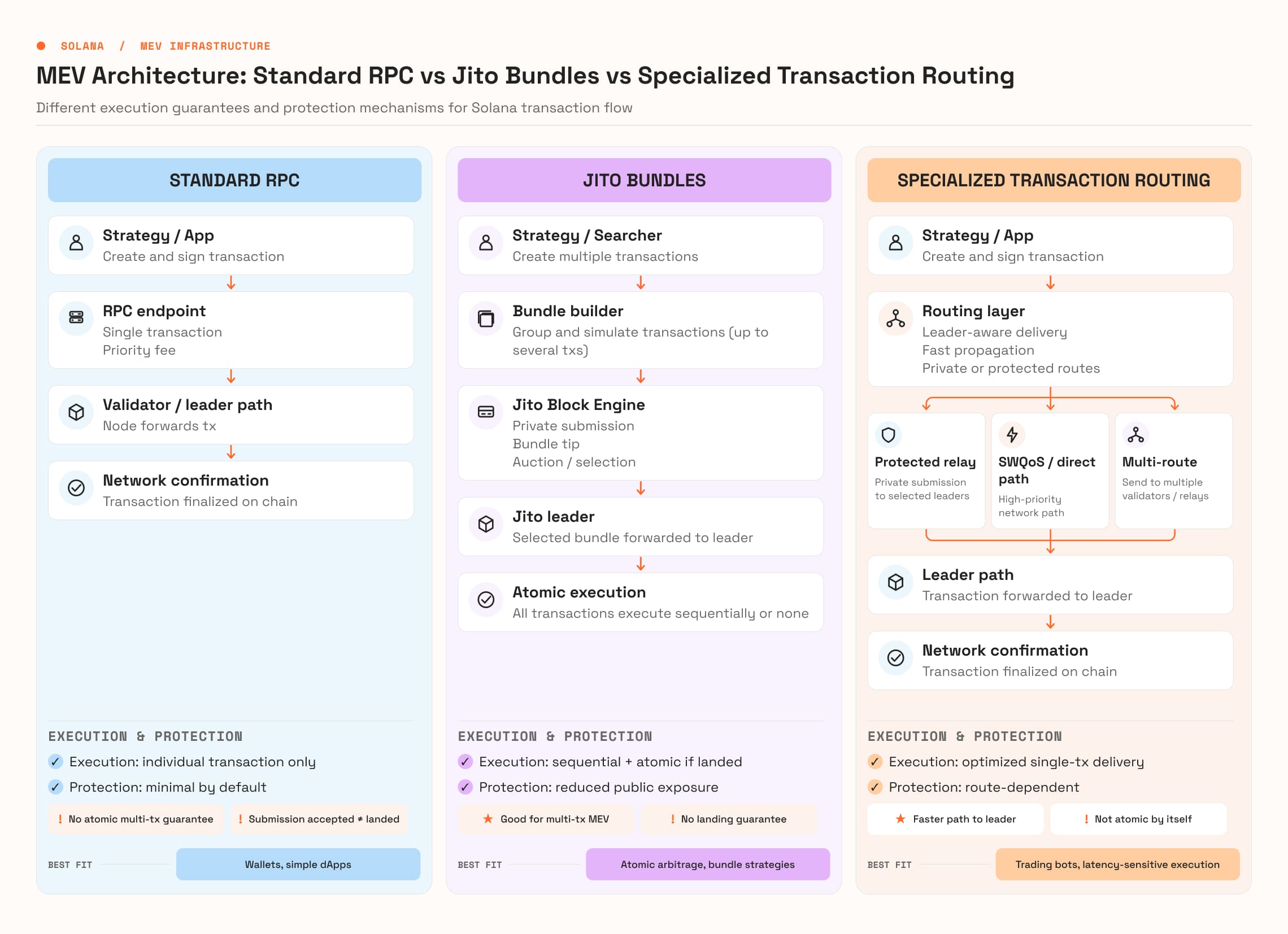
Consider arbitrage requiring two separate transactions. If the first lands and the second fails, the strategy faces partial-execution risk. A properly constructed atomic bundle ties the transactions together under the bundle execution model.
Helius Sender addresses another problem: routing transactions through high-speed submission pathways. Its Sender service includes SWQoS-oriented and priority-routing options, with different tip requirements.
Thus, the practical choice is not necessarily Helius or Jito. It is whether the strategy needs a managed RPC platform, optimized transaction propagation, atomic bundles, or a combination.
For MEV workloads, measure latency across the entire execution sequence. A useful model is:
Signal arrival → Decode → Strategy evaluation → Transaction build → Submission → Confirmation
Different infrastructure components influence different parts.
Shred-based feeds affect data arrival. Yellowstone affects structured event consumption. Jito affects bundle execution and ordering. Transaction relays affect how signed transactions reach leaders. A provider reporting a 10 ms RPC response does not establish a 10 ms trading execution path.

Measure these outcomes separately:
For MEV protection RPC services, distinguish protection against unwanted transaction exposure from atomic execution and revert protection. They are not equivalent guarantees.
Jito bundle economics include both network fees and tip bidding. Jito documents a minimum bundle tip of 1,000 lamports, although competitive auctions often require higher bids. Its Block Engine also supports bundleOnly=true for single-transaction bundle submission.
Helius Sender uses a different commercial and routing model. Its documented minimum tip for SWQoS-only submission is 0.000005 SOL, while Sender Max's priority-routing model starts at 0.001 SOL.
These costs are additional to applicable Solana transaction fees. A strategy's submission budget should be based on expected successful outcomes, not merely requests issued.
For example, paying a larger tip for every attempted liquidation might increase landing probability while reducing overall profitability.
The relevant optimization target is:
Net realized strategy value = Gross execution value − Network fees − Tips − Infrastructure costs − Failed-attempt costs
No provider removes the need for this calculation.
Protection requires careful interpretation.
Jito bundles do not guarantee inclusion, and routing through a protected infrastructure service does not eliminate every form of adverse execution. The Jito documentation also discusses exceptional cases involving uncled blocks and transaction rebroadcasting.
A production system should therefore monitor realized execution and protection assumptions rather than rely on a product label.
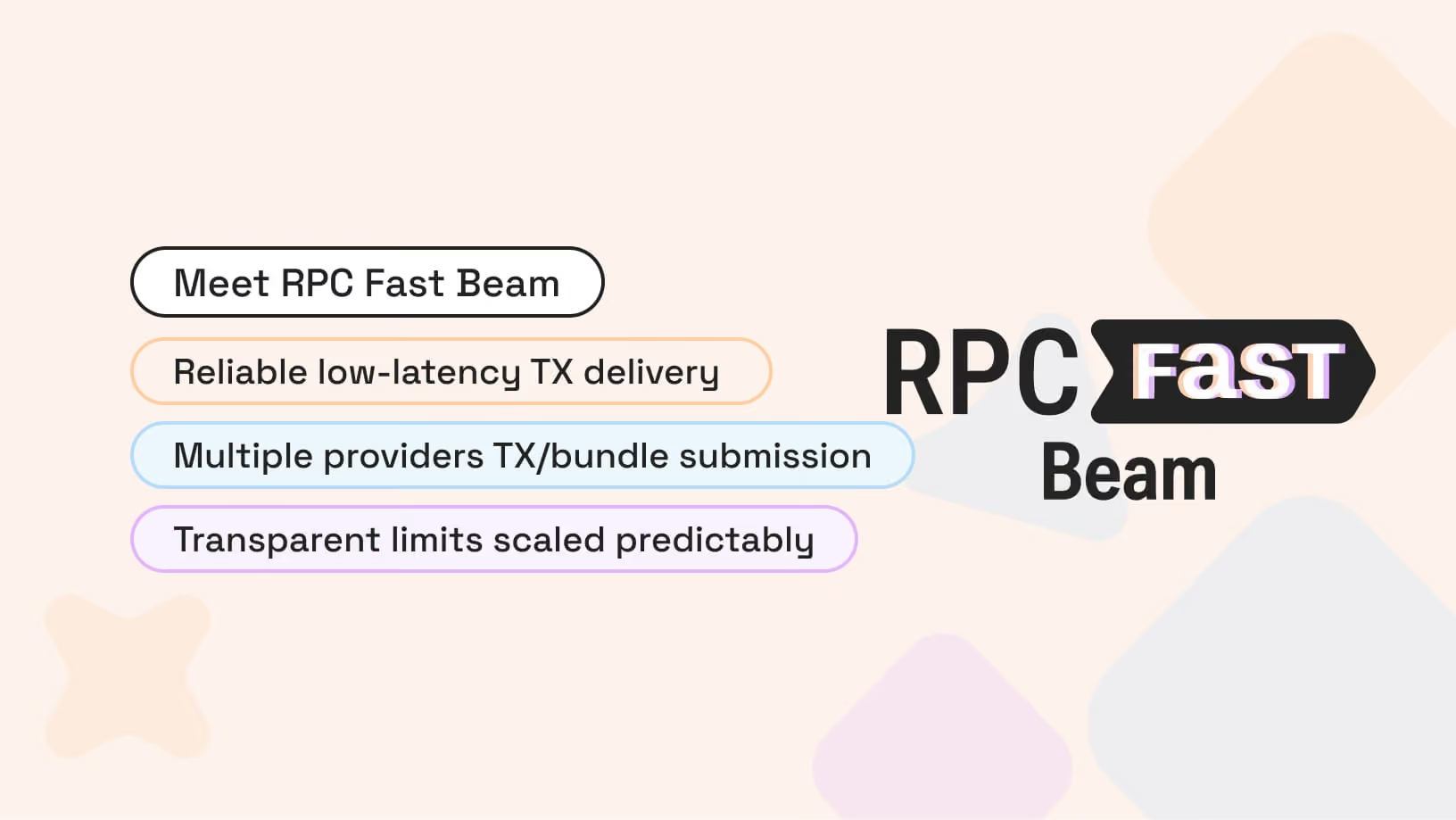
RPC Fast Beam serves as a transaction delivery layer between strategy execution and Solana leader infrastructure.
It includes multiple partner routes and supports two relevant operating modes:
fastest prioritizes transaction delivery performance.mev_protect uses supported protected routes for sensitive order flow.These modes address different requirements. Protection-oriented submission is not automatically the fastest option.
RPC Fast also offers Aperture TxStream for early transaction visibility, allowing a trading application to combine data ingestion and transaction delivery within the same infrastructure ecosystem.
Its published benchmark reports Beam averaging 330 ms to land versus 457 ms for standard RPC, with p90 landing times of 589 ms and 1,065 ms, respectively.
The May 2026 comparison used a Frankfurt-based test environment with 20 runs per path. Both paths landed the measured transactions. The small sample and controlled environment limit generalization.
For MEV searchers, RPC Fast is a reasonable first evaluation alongside Helius and Jito-native infrastructure. The final choice should follow a route-by-route confirmation benchmark.
Chainstack differentiates itself through node deployment options and a managed-infrastructure model. Its Solana offering includes Global Nodes, Trader Nodes, Dedicated Nodes, Yellowstone gRPC, and specialized transaction submission.
This makes Chainstack more relevant to infrastructure-heavy Solana projects than a comparison based solely on shared RPC pricing suggests.
Chainstack's Global Nodes prioritize access through geographically distributed infrastructure.
Trader Nodes use a more region-specific configuration intended for latency-sensitive applications. According to Chainstack's trading infrastructure overview, Trader Nodes include Jito Shredstream-based data propagation.
Dedicated Nodes address another requirement: workload isolation.
Shared infrastructure introduces contention from unrelated users. Dedicated capacity reduces that particular source of variation, but it does not remove Solana congestion, validator restarts, or network propagation delays.
Chainstack supports more than 70 blockchain networks, including Solana and major EVM ecosystems. That makes it a practical alternative to QuickNode and Alchemy for teams operating heterogeneous blockchain infrastructure.
The Chainstack vs Helius decision often reflects different operating models.
Helius specializes in managed Solana functionality. Chainstack emphasizes flexible node deployment across several ecosystems. Neither is universally preferable.
If your engineering team maintains EVM RPC, Solana analytics, and dedicated blockchain nodes, consolidating these workloads through Chainstack might simplify provisioning and commercial management.
For a Solana application heavily dependent on Helius-specific APIs, a migration to Chainstack requires replacing more than its RPC endpoint.
Chainstack offers paid deployment tiers, dedicated-node options, monitoring, and separately billed infrastructure extensions. But one important limitation is easy to miss when comparing pricing tables.
Chainstack's general Developer and Growth plans advertise 25 and 250 RPS respectively. However, its October 2026 Solana-specific docs list 5 RPS for Solana Mainnet on Developer and 50 RPS on Growth.
Some methods have additional limits. This is a useful example of why generic platform specifications should not substitute for protocol-specific documentation.
That is a more useful comparison than looking at Growth's $49 base price alone.
Chainstack and RPC Fast overlap most directly in specialized trading infrastructure. Both offer services beyond generic RPC, including region-sensitive deployment, streaming, and optimized transaction delivery.
The differentiation involves product packaging and workload focus.
Chainstack provides multiple deployment models and a relatively broad infrastructure platform. RPC Fast concentrates on Solana data acquisition, trading-specific processing, Beam routing, and dedicated high-performance nodes.
For a team comparing Chainstack alternatives for low-latency Solana RPC, the selection should start with three questions:
RPC Fast becomes particularly relevant when the second and third questions involve a latency-sensitive trading workload. Chainstack remains a viable choice when deployment flexibility and multi-chain consolidation matter more.
RPC Fast is designed around a narrower infrastructure problem: delivering current Solana state, processing transaction signals, and supporting efficient transaction execution. That specialization is valuable in HFT and MEV workloads. It does not make RPC Fast the default answer for every Solana application.
There are three especially relevant scenarios.
1. Filtered DeFi account reads
RPC Fast's Quark engine accelerates selected getProgramAccounts workloads by using an optimized account-data execution path. A published Quark benchmark reports a 0.032 ms response for a filtered Pump AMM pair query compared with 33.7 seconds through the Agave comparison path.
This result comes from a specific warmed query and benchmark configuration, not an arbitrary getProgramAccounts request. It also does not establish the same speedup over Helius, QuickNode, Alchemy, or Chainstack.
The engineering lesson is that program IDs, filters, cache conditions, and response shapes dominate heavy-query performance.
2. Earlier decoded transaction data
Aperture TxStream provides reconstructed transaction data with server-side decoding, filtering, and optional simulation-related information.
Its published comparison reports first delivery ahead of Yellowstone gRPC in 99.8% of 103,073 matched transactions under the documented test configuration.
The comparison concerns the tested feeds, not all competing providers.
For applications that otherwise maintain their own shred reconstruction and decoding pipeline, removing that work reduces application complexity alongside delivery latency.
3. Specialized transaction submission
Beam routes signed transactions through supported infrastructure paths rather than relying exclusively on ordinary RPC forwarding. The benefit becomes relevant when confirmation latency and landing variance affect the strategy's realized revenue.
Dysnix also offers Solana HFT infrastructure engineering for workloads requiring dedicated deployment, tuning, and operational management.
RPC Fast's specialization introduces several constraints.
These limitations should form part of the evaluation rather than appear only after deployment.
RPC Fast lists four main Solana SaaS tiers.
Source: RPC Fast pricing.
A cheap RPC provider by subscription price is not necessarily a budget-friendly RPC choice at production scale. Consider a trading backend that makes two million getProgramAccounts calls monthly.
Under RPC Fast's documented ten-CU charge for this standard heavy method, that represents approximately 20M CU before other requests. The 12M-CU Focus allocation is therefore insufficient for the example, even though its 50 RPS might be enough for the average request rate.
The next question concerns query behavior. Two million filtered, narrow account reads are operationally different from two million broad account scans.
A better cost model uses actual method mix, peak throughput, streaming volume, and the infrastructure needed to meet response-time objectives.
RPC Fast lists community support for Start, email support for Focus and Stream, and priority chat support for Aperture. Its published first-response support targets are 24 hours for Focus, 12 hours for Stream, and eight hours for Aperture.
These are initial-response commitments, not complete incident-resolution guarantees.
Dedicated infrastructure offers a different engagement model, including direct communication with infrastructure engineers and deployment-specific operational arrangements.
For critical applications, establish the incident escalation path before an outage.
Ask every provider about support coverage hours, emergency escalation, maintenance notifications, and the difference between platform availability targets and the actual application recovery objective.
For standard Solana JSON-RPC, initial integration with RPC Fast is straightforward. The application receives a provider-specific HTTPS endpoint and credentials, then continues using standard methods such as getAccountInfo, getLatestBlockhash, and sendTransaction.
The same RPC Fast project identity supports access to multiple RPC Fast products, reducing credential-management overhead within its ecosystem.
However, moving an existing Yellowstone, proprietary websocket, or Jito integration involves additional configuration.
An application should not assume that every provider-specific API has identical authentication, subscription behavior, or transaction routing. The safe approach is to validate ordinary JSON-RPC first, then migrate the specialized execution paths independently.
Don't select an RPC provider independently of the application's data architecture. Sometimes the correct solution is to use two providers. Sometimes it is to introduce a local cache or indexer. For certain workloads, a self-operated node becomes justified.
A hybrid architecture is often more resilient than relying on a single provider for everything. For example:
The objective is failure independence and appropriate specialization. A secondary endpoint hosted in another region but served by the same underlying infrastructure might not provide genuine provider-level redundancy.
Teams should distinguish geographical diversity from failure-domain diversity.
Also, do not distribute sensitive transactions indiscriminately. Parallel submission requires a deliberate approach to transaction privacy, deduplication, fees, and confirmation tracking.
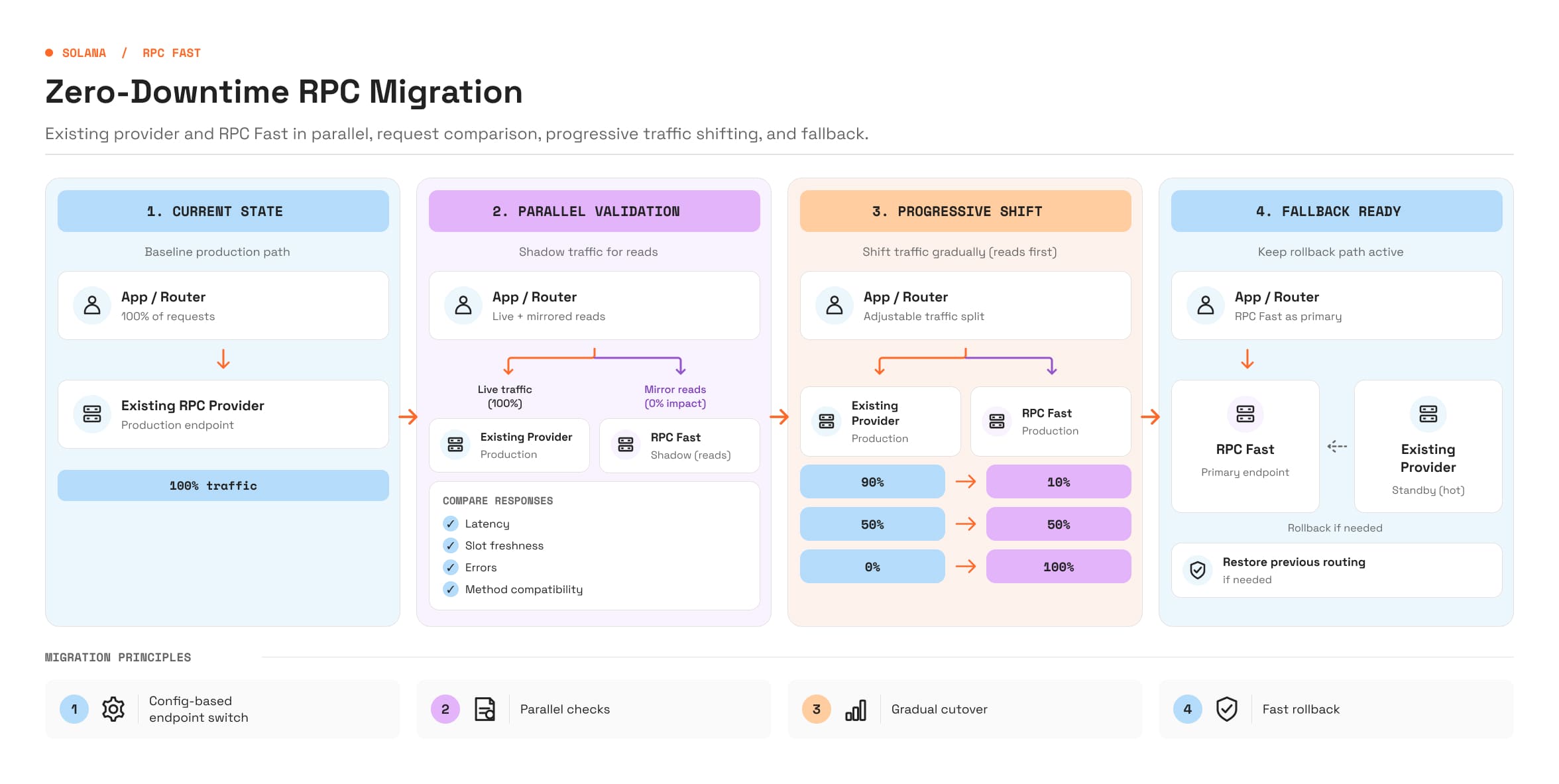
For applications using standard Solana JSON-RPC, migration begins with changing the configured endpoint and credentials. The operational requirement is larger: switch RPC provider without downtime by running the old and new paths in parallel before redirecting production traffic.
This preserves rollback capability and exposes differences before they affect users or trading systems.
Inventory all blockchain infrastructure dependencies before changing the endpoint. At minimum, identify:
Pay special attention to provider-specific functionality. A standard getTransaction call is portable. A managed webhook, proprietary asset API, or customized gRPC payload might not be. A zero-downtime migration should preserve application semantics, not merely HTTP connectivity.
1. Provision the RPC Fast endpoint
Create a project, select the appropriate tier, and obtain its endpoint and access credentials through the RPC Fast platform.
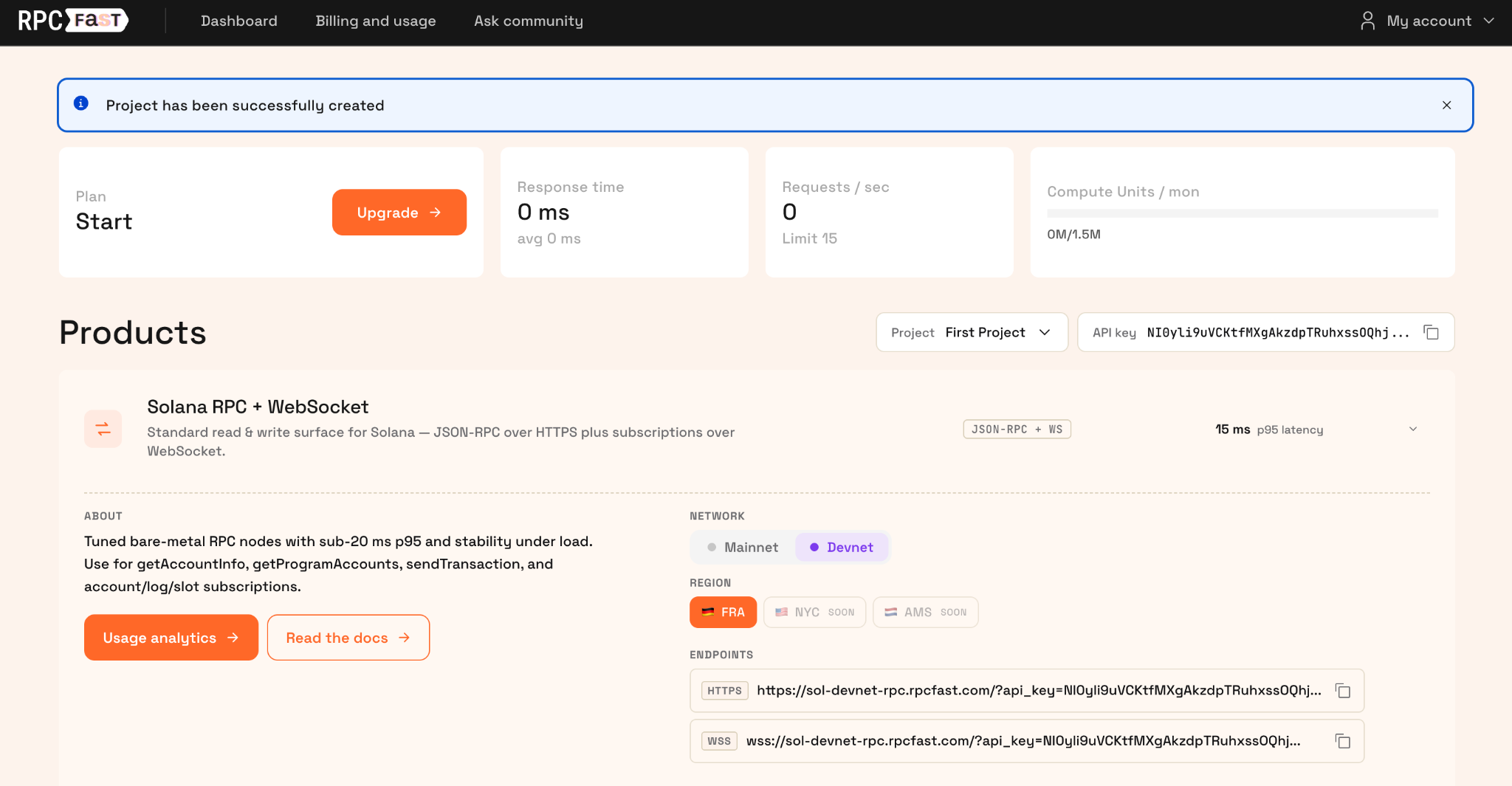
Start supports basic connectivity checks, but advanced application validation requires a plan that matches the methods and streams used in production.
2. Move the endpoint into configuration
Avoid hardcoding a single provider URL throughout the application. For example, a TypeScript application using @solana/web3.js might construct its connection as follows:
import { Connection } from "@solana/web3.js";

const rpcUrl = process.env.SOLANA_RPC_URL;

if (!rpcUrl) {
  throw new Error("SOLANA_RPC_URL is not configured");
}

const connection = new Connection(rpcUrl, {
  commitment: "confirmed",
});
The initial provider remains configured for existing production instances. Introduce RPC Fast through environment configuration, a connection factory, or an application-level routing layer.
3. Validate basic compatibility
Call getHealth, getSlot, getLatestBlockhash, and representative account-reading methods. Verify that the new endpoint supports the same commitment requirements and response structures.
Where provider state differs near the chain tip, compare context slots rather than expecting two independently synchronized nodes to return identical responses at every instant.
4. Run shadow traffic
Send a sample of read-only production requests to both providers. Return the original provider's response to the application while recording the secondary response and latency. Compare:
Shadow requests consume both providers' quotas, so budget accordingly.
5. Shift production traffic gradually
Move a small share of reads first, then increase the proportion as monitoring confirms acceptable behavior. Keep the old provider available for fallback throughout the transition.
Use a different procedure for transaction submission. Avoid blindly duplicating newly constructed transactions, particularly when tip instructions, route policies, or blockhashes differ. If the same signed transaction is distributed across approved routes, deduplicate and track it by signature.
6. Migrate streams and specialized routes
Recreate WebSocket subscriptions using the new connection details.
These integrations require more than a plain HTTPS URL replacement.
The most useful migration test reproduces production behavior rather than a synthetic endpoint health check.
A controlled experiment should keep the strategy logic, transaction construction, priority fees, and test region as consistent as possible.
Illustrative acceptance criteria, to be adjusted against the existing production baseline:
A fixed universal latency threshold would be less useful than these workload-specific acceptance gates.
After migration, monitor the new endpoint as an application dependency. The minimum observability set should include RPC request rates, latency distributions, 429 responses, method-level errors, and compute-unit consumption.
Streaming services require additional metrics: latest observed slot, slot gaps, reconnects, consumer lag, duplicates, and message delivery time.
Trading systems need separate execution metrics: submitted transactions, landed transactions, expirations, failed attempts, tips, priority fees, and confirmation latency.
Alert on symptoms that affect application outcomes.
For example, a 5 ms increase in average RPC latency might be insignificant for a wallet UI. The same increase in first-signal latency might matter for a competitive trading strategy.
Finally, retain a secondary provider where the business impact justifies the expense. Zero-downtime migration is one operational event; continuous recovery capability is a separate infrastructure requirement.
The right selection depends on whether the application prioritizes developer convenience, multi-chain integration, controlled infrastructure, or competitive transaction execution.
There is no universal best Solana RPC endpoint across all workloads.
A public pricing table does not establish a provider's production suitability. This comparison uses official documentation and published benchmarks. It is not presented as a Dysnix-controlled five-provider benchmark; a neutral test would require identical workloads, client locations, measurement windows, and transaction submission conditions.
From an infrastructure engineering perspective, five principles drive the decision:
A fast response containing stale state might be less useful than a slightly slower response from a node tracking the latest slot. Measure both.
Yellowstone gRPC, WebSockets, and shred-derived feeds deliver different information with different processing requirements. A structured stream reduces client parsing work; earlier raw data might require additional application infrastructure.
Solana RPC acceptance does not guarantee inclusion. Trading systems need confirmation-based metrics, fee management, and appropriate leader routes.
Credits, compute units, request units, and streaming bandwidth are not interchangeable. Estimate costs using actual methods, request rates, data volumes, and deployment requirements.
Critical applications benefit from understanding failure domains, maintaining fallback options, and separating latency-critical paths from ordinary application traffic.
Choose Helius for Solana-oriented developer services, QuickNode for multi-chain platform consolidation, Alchemy for usage-oriented infrastructure and data products, and Chainstack for deployment flexibility.
Choose RPC Fast when Solana data delivery, transaction propagation, and dedicated trading infrastructure form a measurable part of your application's performance requirements.
For ordinary wallets and dApps without strict timing requirements, expensive streaming tiers and dedicated hardware are often unnecessary.
Provider differentiation is shifting beyond raw JSON-RPC response times. Key offerings include earlier transaction data, selective stream processing, dedicated account-query engines, leader-aware transaction routing, and tighter integration between streaming and execution systems.
At the same time, infrastructure economics increasingly depend on workload-specific charging and data-transfer costs.
These changes strengthen the case for selecting infrastructure based on a measured application workflow rather than an advertised endpoint speed.

Build faster with private RPC by Dysnix
Dedicated endpoints, gRPC, and raw streams for trading, AI agents, and dApps.
Test for free